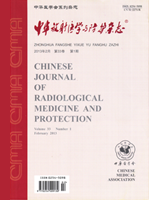
测试环境采编刊群
2018年 · 第38卷第02期
测试环境采编刊群
March 11, 2011 An earthquake of magnitude 9.0 on the Richter scale occurred off the Pacific Ocean in northeastern Japan and triggered a tsunami. The 15 m high tsunami caused four units of Fukushima Daiichi nuclear power plant to lose cooling and then hydrogen explosion, causing a large amount of radioactive material to be released,131I equivalent release amount is (3.7~6.3) ×1017Bq. After the nuclear accident, a total of 17,000 people participated in the emergency rescue work from March to September. By the end of 2017, 4 rescue workers have applied for work-related injury identification. The relevant situation is reported as follows:
Professor Wei Luxin, one of the pioneers and founders of radiation health in China and one of the founders of Chinese Journal of Radiation Medicine and Protection, died at 00: 05 on January 14, 2018 in Beijing at the age of 96 due to ineffective treatment.
Occupational exposure surveillance of nuclear medicine workers and prevention and control of radiation diseases are the focus of attention. Because more nuclides are used in nuclear medicine diagnosis and treatment, if any131I,99TcmAnd18F et al., per capita annual doses may be higher than other radiation workers, producing radiation-specific posterior capsular opacity of the posterior pole of the ocular lens, and131I The dosage is large and volatile. If the protection is not appropriate, the workers will be exposed to internal irradiation when they ingest radionuclides. However, there are few reports on the necessity judgment, monitoring methods and dose estimation of internal exposure monitoring in China.
本期目次