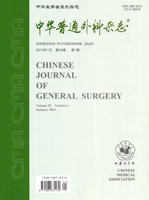
中华普通外科杂志
2015年 · 第30卷第11期
中华普通外科杂志
In the surgical treatment of liver cancer, the relationship between risk and benefit is relative. Surgeons don't have liver tumors that can't be cut, but whether the body can tolerate them. The key is how to cut it and whether it makes sense. What kind of treatment is the most suitable for patients, and what kind of treatment can make patients obtain long-term satisfactory survival, all of which need us to evaluate the patient's condition and economic status comprehensively, and obtain the maximum benefit with the smallest risk. Of course, different treatment methods have different risks and benefits. In the current special medical environment, we mainly discuss the risks and benefits of surgical treatment of liver cancer.
In this study, the expression of five multidrug resistance gene-related proteins: DNA topoisomerase Ⅱ (Topo Ⅱ), P-glycoprotein (P-gp), lung resistance-related protein (LRP), multidrug resistance-associated protein (MRP) and glutathione S-transferase-π (GST-π) in adenocarcinoma of gastroesophageal junction (AGEJ) was detected, so as to find reliable predictors of chemosensitivity and provide an important basis for the individualized treatment of AGEJ.
Rectal cancer is one of the most common digestive tract malignancies[
Studies have shown that Stathmin protein is closely related to the development of many human tumors[
Appendicectomy is an effective treatment for appendicitis. laparoscopic appendectomy (LA) has the advantages of less trauma and fast recovery[
Severe pancreatic rupture is often combined with other organ injuries. At the same time, due to the leakage and corrosion of pancreatic juice, the injury becomes complicated, and complications such as pancreatic fistula are easy to form after operation, which makes it difficult to treat[
percutaneous laser ablation (PLA) is a minimally invasive therapeutic technique developed gradually in recent years. It has been used by foreign scholars to treat benign thyroid nodules, thyroid autonomic functional adenomas and recurrent thyroid malignant tumors, and the clinical results are satisfactory[
Bile duct injury is a serious complication of laparoscopic cholecystectomy. The incidence rate of bile duct injury in laparoscopic cholecystectomy in China is 0.19%[
The patient was a 65-year-old female. The main reason was upper abdominal discomfort. After eating, I felt obvious upper abdominal fullness, and the symptoms worsened recently. B-ultrasound in the local county hospital 2 days before admission showed splenomegaly and multiple hyperechoic nodules in the spleen. Blood routine: WBC 21.37×10⁹/L, RBC 5.78×10¹²/L, PLT 432×109/L, liver, kidney function, electrolyte indexes were normal. CT showed: splenomegaly, uneven and wavy edges, low-density shadows in the spleen, but lymphoma was not excluded. Both bone marrow punctures were dry draw and blood smears: middle and late granulocytes, megakaryocytes, nucleated red blood cells and platelet accumulation distribution were seen. Clinical diagnosis: spleen occupying space, splenomegaly. The patient underwent splenectomy after completing relevant examinations. During the operation, adhesion between the upper pole of the spleen and the diaphragm was found. The size of the spleen was 26 cm ×17 cm ×9 cm. There were no enlarged lymph nodes around the spleen, free splenic pedicle and residual perisplenic ligament. The spleen was completely removed and sent for pathological examination. The size of the spleen submitted for examination was 25 cm ×18 cm ×7 cm. The volume of the spleen was obviously increased, the surface was swollen and smooth, and the capsule was intact. Book-shaped incision, the spleen section is dark red, the red pulp is congested and swollen, the section can see bleeding, nodular, the spleen tissue at the bleeding site is slightly spongy, the size is 3 cm ×2 cm, the white pulp is atrophic and brittle.
The patient was a 27-year-old female. I was admitted to hospital for 1 d with upper abdominal pain, which was persistent tingling without release. No nausea, vomiting, no fever, yellowness, no diarrhea and tenesea. No frequent urination, urgency and painful urination. Physical examination: abdominal breathing was weakened, upper abdominal tenderness, mainly in the left upper abdomen, accompanied by rebound pain and mild muscle tension. Murrphy sign negative. The liver and gallbladder are not palpable under the costs, but the spleen is palpable under the costs. Percussion pain was obvious in the spleen area. Blood routine: WBC: 14.28×10⁹/L, RBC: 3.76×10¹²/L, HGB: 87 g/L. Coagulation routine : PT-sec: 11.5 s, PT-INR: 0.84, PT: 111.00%, FIB: 4.59 g/L, TT: 14.7 s. There was no abnormality in urine routine and no abnormality in liver function. There were no abnormalities in ECG and chest radiographs. Tumor markers : CEA: 0.71 ng/ml, CA-199 153.35 U/ml. Abdominal CT showed: the spleen was enlarged, about 11.6 cm ×6.1 cm in size, the CT value was 40 HU, and the intestinal canal, left kidney and pancreas in the abdominal cavity were compressed, displaced and deformed. After the enhanced scan, there was no obvious enhancement in the arterial phase, delayed phase and spleen parenchyma, and the CT value was about 42 HU; The splenic artery was not developed behind the splenic hilum, the splenic artery was not obviously thickened or dilated, the splenic vein was not filled with contrast medium, the splenic vein was spiral in shape, and a small amount of fluid accumulation was seen around the spleen (
Aortic dissection is a state in which the intima of the aortic wall is ruptured, and the arterial blood flow enters the aortic wall to divide it into true lumen and false lumen. The clinical manifestation is dangerous and the mortality rate is high[
A large amount of mucoid substance accumulates in the extrahepatic biliary tract, causing obstruction and dilation of the biliary tract, which in turn leads to obstructive jaundice and/or cholangitis, known as mucobilia, 1987 by Hadjis[
At present, the surgical technique and perioperative management of liver transplantation are quite mature, but the long-term survival rate of liver transplantation recipients still needs to be improved. According to the China Liver Transplant Registry (CLTR) database, the 10-year survival rate after liver transplantation is less than 60%[
本期目次