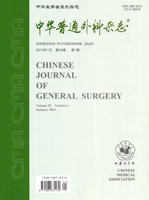
中华普通外科杂志
2015年 · 第30卷第09期
中华普通外科杂志
Since the first case of parathyroid carcinoma (PC) was recorded in 1904, less than 2,000 cases have been reported in English literature, and about 200 cases have been reported in domestic literature[
A 38-year-old female was found to occupy cystic space in the abdominal cavity near the spleen for 5 months without abdominal pain, abdominal distension, nausea and vomiting, and no definite diagnosis and treatment was given. History of previous cesarean section, no other chronic diseases, trauma or surgical history. Abdominal CT in our hospital showed that cystic mass occupied at the splenic hilum of the tail of the pancreas (
A 50-year-old female was admitted to hospital for "left breast mass for three years with areola nipple pruritus and ulceration for two years". The patient accidentally discovered a left breast mass three years ago. Two years ago, the left areola and nipple showed itching and discomfort, accompanied by ulceration and intermittent pale yellow discharge, and the ulceration surface gradually spread to all areolas. Physical examination: The left nipple defect was fused with the areola, and the appearance was slightly reddened, swollen, rough, thickened and tender. At 11 o'clock in the inner upper quadrant of the left breast, a mass with medium size of about 1.5 cm ×1.0 cm, poor mobility, unclear boundary and no tenderness was touched at about 1.5 cm from the edge of the areola. No enlarged lymph nodes were palpable under bilateral axillaries. The tumor markers CEA, AFP, CA125, CA153 and CA199 were all normal. Thoracic and abdominal CT showed no obvious abnormalities. Under local anesthesia, a fusiform incision of the left breast was taken to remove part of the areola and the inner upper quadrant mass, and frozen during the operation: high-grade intraepithelial neoplasia (severe dysplasia) of the squamous epithelium of the left breast mass and Paget's disease of the left areola. Then modified radical mastectomy of left breast under general anesthesia was performed. Postoperative pathology: Left breast squamous cell carcinoma (
An 18-year-old female was found to have a slow increase in the mass at the front of the neck for 3 years. Color ultrasound in the local hospital showed: a subcutaneous cystic-solid echo mass at the level of the median hyoid bone at the front of the neck, with a size of about 25 mm ×12 mm, a clear boundary, and a punctate strong echo. Color Doppler flow imaging showed an abnormal echo mass, and a small amount of blood flow signal could be seen in the solid part. Solid heterogeneous hypoechoic masses were observed in both thyroid lobes. No abnormalities in thyroid function were found, thyroglossal duct cyst was diagnosed, and "thyroglossal duct cyst resection" was performed in the local hospital. The cyst and part of the hyoid bone were completely removed during the operation. Postoperative pathology: The morphology was consistent with the papillary carcinoma of thyroid origin. The cancer cells invaded the striated muscle, and a small number of abnormal cells were seen in the hyoid bone tissue. Postoperative oral Tc99mScan: No abnormal concentration and sparse areas were found in the neck (
The patient was a 33-year-old male. He was admitted to hospital for 17 years due to intermittent painless hematochezia, aggravated with anemia and fatigue for 2 years. Physical examination: anemia appearance, an old surgical scar about 20 cm long was seen on both buttocks, and blue-purple tumor-like varicose veins were seen on the skin of the penis and scrotum, protruding from the skin surface. A cluster of nevus, about 3 cm ×4 cm in size, was seen on the left side of the anus (
The patient, 50-year-old female, was admitted for 1 d with abdominal pain. Abdominal pain is mainly in the upper abdomen, which is persistent dull pain, no back tightness, no fever, no nausea, vomiting, no hematemesis and melena. Admission physical examination: mild anemia appearance, unpalpable swelling of superficial lymph nodes. All abdominal softness, tenderness in the upper abdomen, no muscle tension and rebound pain, and negative mobile voicing. Laboratory tests: Blood routine: Hb 8.9 g/L. Abdominal enhanced CT revealed a solid mass in the left upper abdominal sac, the solid part was obviously enhanced, originating from the large curvature of the stomach, and fluid density shadows were seen around and in the left paracolonic sulcus, which was considered as the possibility of gastric stromal tumor with rupture (
Massive hemorrhage is considered to be one of the main factors of serious complications and prognosis of liver surgery. When the blood flow into the liver is blocked, the hemorrhage during hepatectomy mainly comes from the reflux of the hepatic vein and the short hepatic vein. Hepatic vein hemorrhage is closely related to central venous pressure (CVP)[
thromboangiitis obliterans (TAO) is a vascular inflammatory disease that occurs in young and middle-aged men who smoke cigarettes. Small and medium arteries and veins are often involved, causing stenosis of the arteries of the lower and upper limbs[
The principle of surgical treatment of choledocholithiasis is to relieve the obstruction, remove the lesion and unobstructed drainage. After laparoscopic common bile duct exploration (LCBDE), the primary suture method of common bile duct has the advantages of less pain, faster recovery and less complications than the traditional T-tube drainage. In recent years, 59 cases of laparoscopic common bile duct suture and intraoperative common bile duct angiography were completed in our hospital. No bile leakage, residual bile duct stones and bile duct stenosis were found after operation, and the treatment effect was satisfactory. The report is as follows.
Plasmcell mastitis (PCM) occurs in non-lactating young women. Traditional surgical treatment is easy to destroy the shape and has a high recurrence rate[
congenital internal hernias (CIH) is one of the rare causes of intestinal obstruction[
The necrosis and ulceration of huge tumors on the body surface is accompanied by severe infection, and the infection is prolonged, so the treatment is very difficult; Extended tumor resection is the only way to treat such patients. Because of the large surgical wound, autologous skin grafting is needed. For contaminated surgery, skin grafting fails due to secondary infection after surgery. In view of this, 7 cases of huge tumor with necrosis accompanied by infection were treated in our department. Extended tumor resection was performed, and vacuum sealing drainage (VSD) was used to avoid postoperative wound infection. Second-stage skin grafting achieved good results. The summary report is as follows.
thyroid cancer is the most common malignant tumor in human endocrine system, and its incidence has increased rapidly in recent years. papillary thyroid carcinoma (PTC) is the most common pathological tissue type of thyroid cancer, and about 38.2% of the new cases of papillary thyroid carcinoma in China[
pancreatic segmental portal hypertension (PSPH) is a rare extrahepatic portal hypertension caused by pancreatic diseases, and its incidence is increasing year by year in recent years. As a possible cure portal hypertension, it is especially important to diagnose and treat it in a timely and accurate manner. In the past, due to the low incidence of this disease, the understanding of it is insufficient, which makes the treatment of PSPH single. In this paper, the individualized treatment of PSPH is proposed for the first time, and its etiology, clinical manifestation, auxiliary examination and various treatment methods are reviewed.
Because of the changes in diet structure, population growth and aging, vascular disease has become the most common disease that threatens the health of Chinese people. Surgical reconstruction of blood flow is an important method for the treatment of vascular diseases; Selecting appropriate vascular graft materials is crucial to the efficacy of surgery. Vascular graft materials mainly include autologous blood vessels, allogeneic blood vessels, artificial blood vessels and tissue engineered blood vessels. Autologous blood vessels such as great saphenous vein have no immune rejection and high near-and long-term patency. They are widely used in lower limb arterial bypass grafting[
本期目次